Wan Video
MLX-Gen supports Wan2.2 text-to-video and image-to-video through mlxgen generate, plus
prompt-guided video-to-video on Wan2.2-T2V-A14B in plain form or with --video-mask-path. Use
this page for practical size, frame, and runtime guidance; use API and CLI for
the full command surface.
For ordinary reference-image-to-video and reference-guided source-video editing, use the separate Bernini-R 1.3B renderer. Bernini shares Wan components but has different packed source-ID conditioning, guidance, precision, and canvas contracts.
Current Practical Guidance
Single shots default to 81 frames across the Wan family, and 81 is the recommended shot
length: the A14B models train at 81 frames, and longer single shots drift toward a ping-pong
ending that returns to the first frame (see the
FAQ entry on long image-to-video clips).
For longer results, chain shots with SVI continuation or context-frame conditioning rather than
raising --frames on one shot. TI2V-5B natively supports up to 121 frames; pass --frames 121
explicitly for its full-length shots.
Wan A14B is the stronger local option in the measured starship example below when you can accept a
smaller canvas. On an Apple M5 Max, a 5.05 second clip at 480x240 or 240x480, 101 frames,
20 fps, and 20 to 25 steps takes about 30 minutes in the local profiles below. For the
specific starship prompt shown here, the documented A14B text-to-video result at 480x240 is the
preferred practical setting over TI2V-5B at 832x480.
TI2V-5B remains useful as the smaller 5B route and supports both text-to-video and first-frame
image-to-video. It uses 32-pixel spatial multiples and is designed around 1280x704 or
704x1280; 832x480 is a practical lower-cost size. A 1280x704, 25 step, 101 frame local
run takes about the same time as the A14B 480x240 profile in this page.
For TI2V-5B, treat smaller canvases below 832x480 as command and prompt-routing checks rather
than visual-quality settings.
Wan uses a flow-matching schedule shift. MLX-Gen uses the selected model's default unless you pass
--flow-shift: TI2V-5B defaults to 5.0 for native 720p-class runs, while A14B defaults to 3.0.
For new 480p-class TI2V-5B checks such as 832x480, use --flow-shift 3.
The public Wan video-to-video route stays intentionally narrow:
Plain video-to-video means one source clip plus one text prompt. MLX-Gen uses the source clip as a
composition anchor, then regenerates the video under the prompt. It is useful for broad
whole-scene or whole-subject changes while keeping the overall camera path. Be precise about what
survives: camera path, framing, and scene layout carry through at typical strengths, but subject
gestures and timing are re-synthesized - the model generates plausible motion, not the source's
exact motion. The measured motion-fidelity ladder below shows where that transition happens. For
exact preservation of a region (including its motion), use --video-mask-path.
Motion Fidelity Versus Strength
--video-strength is not linear: the flow shift warps it, so the warm start keeps far less
source signal than the number suggests. Measured on a subject-swap edit (25 frames, 20 steps,
CFG on, one seed; gesture-timing correlation of the subject region's motion against the source,
where 1.0 = source motion and values below ~0.42 are statistically indistinguishable from
zero). The Lightning row comes from the paired 17-frame control clip, not the 25-frame ladder:
--video-strength |
Warm-start sigma (shift 3) | Source signal kept | Gesture timing r | What you get (in the measured runs) |
|---|---|---|---|---|
| 0.5 | 0.75 | 25% | 0.86 | edit applied, source gestures preserved |
| 0.6 | 0.82 | 18% | 0.90 | edit applied, source gestures preserved |
| 0.7 | 0.88 | 12% | 0.73 | mostly preserved |
| 0.8 (default) | 0.92 | 8% | 0.20 | gestures re-synthesized |
| Lightning recipe (0.75 at shift 5) | 0.94 | 6% | -0.16 to 0.45 (prompt-dependent, paired control) | gestures re-synthesized |
Practical guidance from the ladder (proof bundle with commands, per-run metrics, and contact sheets: motion-ladder-2026-07-05):
- For "keep the motion, change the look" restyles, use
--video-strength 0.5-0.6at 20 steps with CFG on. Below 0.7 the A14B high-noise stage is skipped (--guidanceis inert and a warning prints;--guidance-2carries the CFG on the low-noise expert) - fine for restyling, weaker for adding brand-new objects; use a mask for those. - The 4-step Lightning fast path cannot reach the motion-preserving band: at 4 steps, strength 0.5-0.65 leaves 2 effective steps and drops the high-noise LoRA entirely. Fast and motion-preserving are currently mutually exclusive; pick per clip.
- Prompt wording matters at high noise but cannot lock timing: in a paired control run at the Lightning point, adding "gesturing naturally with his hands" to the prompt restored gesturing where the same seed without it produced hands-on-podium - the class of motion returned, not the source's exact timing.
Motion-preserving restyle recipe (measured settings; adjust canvas, frames, and prompt to your clip):
mlxgen generate \
  --model AbstractFramework/wan2.2-t2v-a14b-diffusers-8bit \
  --video-path source.mp4 \
  --prompt "Describe the restyled subject and what must stay the same" \
  --width 480 --height 832 --frames 25 --fps 16 \
  --steps 20 --guidance 4 --guidance-2 3 --video-strength 0.6 \
  --solver unipc --seed 8602 --low-ram --metadata \
  --output restyled.mp4
Expect the boundary-skip warning: below strength 0.7 the high-noise stage never runs, so
--guidance 4 is inert and --guidance-2 3 provides the classifier-free guidance.
The measured rows are published for inspection (the exact ladder commands are in the bundle README; the strength-0.6 run below used the recipe above with the woman-swap prompt and its custom negative prompt, seed 8602):
- strength 0.6 output (edit applied, gestures preserved, r 0.90): ladder_s06.mp4 + metadata
- strength 0.8 output (gestures re-synthesized, r 0.20): ladder_s08.mp4 + metadata
- paired prompt control at the Lightning point: control_gesture_prompt.mp4 + metadata
- edit-success face crops (source, 0.5, 0.6, 0.7, 0.8):

Temporal and audio contract, in plain terms:
- MLX-Gen resamples the source onto the
--fpstimeline at decode, so the output keeps real-time speed regardless of the source frame rate:--frames 17 --fps 16always consumes the first 1.06 s of the source. Downsampling (for example 30 fps -> 16 fps) drops intermediate frames and prints an informational note; upsampling above the source fps duplicates frames and prints a warning, because duplicated conditioning frames reduce motion smoothness. When source and requested fps already match, frames pass through untouched (bit-identical with earlier releases). Metadata recordssource_video_fpsandsource_video_resampled. - When the source clip has an audio track, the matching audio segment is copied onto the saved
output (trimmed to the output duration). The copy is best-effort: if it cannot be completed
(for example,
ffmpegmissing), the video is saved silent, a warning prints the reason plus a manual remux command, and metadata recordsaudio_copied/audio_copy_reason. This is deliberately softer than the SeedVR2 restore contract, which fails on unpreserved audio: a failed mux must not discard a finished generation.
Included proof (a 30 fps source with an audio track, edited at --fps 16; the output keeps
real-time speed and carries the audio - play the MP4 to hear it):
- source (30 fps, 47 frames, 440 Hz tone): conference_30fps_with_audio.mp4
- output (16 fps, 17 frames, AAC audio, red-necktie edit): red_tie_fps_audio.mp4
- run metadata (
source_video_resampled: true,audio_copied: true): red_tie_fps_audio.metadata.json - contact sheets: source / output
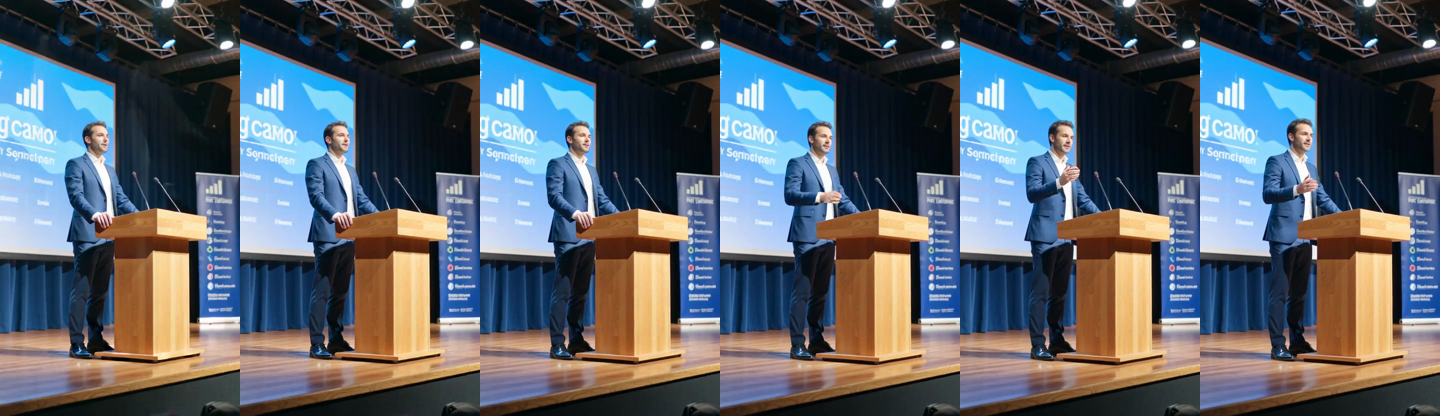
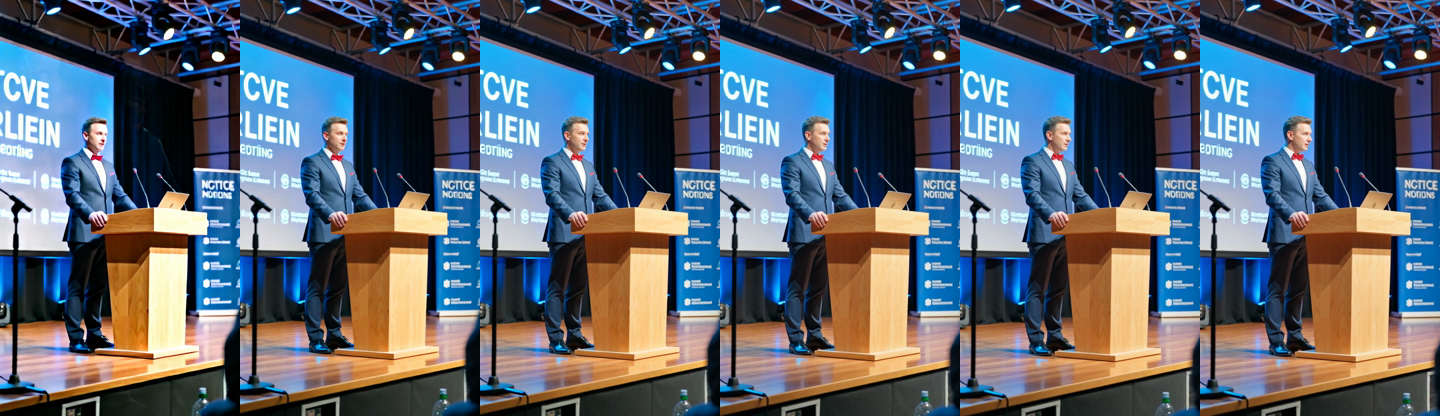
This exact command produced the output above (Lightning fast recipe; the source was derived
from the seed-8601 clip in lightning-v2v-2026-07-04
via ffmpeg -filter_complex "[0:v]fps=30[v]" plus a sine=frequency=440 audio track):
mlxgen generate \
  --model AbstractFramework/wan2.2-t2v-a14b-diffusers-8bit \
  --video-path conference_30fps_with_audio.mp4 \
  --prompt "A man in a dark blue suit stands at a conference speaking to the audience, wearing a bright red necktie, photorealistic, stage lighting" \
  --negative-prompt "cartoon, illustration, low quality, blurry, distorted face" \
  --width 480 --height 832 --frames 17 --fps 16 \
  --steps 4 --video-strength 0.75 --guidance 1 --guidance-2 1 --flow-shift 5 --solver unipc \
  --lora-paths "lightx2v/Wan2.2-Lightning:Wan2.2-T2V-A14B-4steps-lora-rank64-Seko-V1.1/high_noise_model.safetensors" "lightx2v/Wan2.2-Lightning:Wan2.2-T2V-A14B-4steps-lora-rank64-Seko-V1.1/low_noise_model.safetensors" \
  --lora-target-roles high_noise_transformer low_noise_transformer \
  --seed 4242 --low-ram --metadata \
  --output red_tie_fps_audio.mp4
Route rules:
- use
Wan-AI/Wan2.2-T2V-A14B-Diffusersor the matching prepared A14B T2V package; - pass exactly one
--videoor--video-path; - keep
--solver unipc; - use
--video-strengthwhen you want more or less change from the source clip (default0.8); - know the strength contract: the run denoises
floor(steps x video_strength)effective steps, so the saved metadata records both your requestedstepsand the resolvedeffective_steps; - know that below roughly
--video-strength 0.7the A14B high-noise stage is skipped,--guidancebecomes inactive, and only--guidance-2shapes the result; MLX-Gen prints a warning when this happens; - match the requested
--width/--heightaspect ratio to the source clip: plain video-to-video stretches source frames to the requested canvas and warns on a mismatch, unlike image-to-video which preserves the source aspect ratio; - use
--video-mask-pathwhen you want the background locked to the source (see Masked Video-To-Video below); - do not expect reference images, control videos, SeedVR2-style restore/upscale behavior, or
VACE-style learned conditioning on this A14B route - those live on the natively ported
wan-vacemodel (see VACE below) or the role-aware Bernini renderer; - do not expect TI2V-5B or I2V-A14B to accept source-video input on the public CLI.
Continuing A Clip: Multi-Frame Context Conditioning
When a new A14B image-to-video clip continues an existing shot, seeding it from ONE still frame
resets the motion: one frame carries no velocity, so the continuation restarts at whatever speed
and direction the model guesses. --context-frames hands over the predecessor's last K frames
instead (the SkyReels-V2/SVI-class multi-frame handover): --image-path takes the FIRST frame of
the handover window and --context-frames the ordered rest — 4, 8, or 12 frames, so the
conditioned head (5, 9, or 13 frames) fills whole 4x VAE latent groups.
# Predecessor tail frames f44..f48 extracted as ONGs; head = 5 frames.
mlxgen generate --model AbstractFramework/wan2.2-i2v-a14b-diffusers-8bit \
  --prompt "the ship continues rising, camera static" \
  --image f44.png --context-frames f45.png f46.png f47.png f48.png \
  --width 480 --height 272 --frames 49 --fps 16 \
  --steps 4 --guidance 1.0 --guidance-2 1.0 --flow-shift 5.0 --seed 5151 \
  --lora-paths "lightx2v/Wan2.2-Lightning:Wan2.2-I2V-A14B-4steps-lora-rank64-Seko-V1/high_noise_model.safetensors" \
               "lightx2v/Wan2.2-Lightning:Wan2.2-I2V-A14B-4steps-lora-rank64-Seko-V1/low_noise_model.safetensors" \
  --lora-scales 1.0 1.0 --lora-target-roles high_noise_transformer low_noise_transformer
The continuation regenerates the head frames (conditioned, not copied), so a host assembling a
film should trim the predecessor at the FIRST handover frame to avoid double-play. This is
EXPERIMENTAL zero-shot behavior on Wan 2.2 A14B — measured bounds, the boundary flare artifact,
and the --context-noise knob are documented in the API table and backlog item 0102.
Chaining Clips With A Persistent Identity Anchor: SVI 2.0 Pro
Multi-frame context conditioning carries momentum, but nothing in it re-states WHO the subject is:
over long chains the subject drifts. SVI 2.0 Pro (Stable Video Infinity, ICLR'26 Oral, trained for
Wan 2.2 A14B i2v) restructures the conditioning of every clip as
[anchor_latent, motion_latent, zero-latents]: one persistent anchor image is re-injected into
EVERY clip of the chain (identity), the previous clip's final denoised latent hands the motion
over losslessly (momentum), and an error-recycling LoRA pair teaches the model to recover from its
own accumulated errors (drift resistance). MLX-Gen ships this as an EXPERIMENTAL mode:
# Clip 1: the anchor IS the first frame; the run exports clip1.svi_latent.safetensors.
mlxgen generate --model AbstractFramework/wan2.2-i2v-a14b-diffusers-8bit \
  --prompt "a silver survey drone hovering low over a geyser field, camera static" \
  --svi-anchor-image anchor.png \
  --svi-lora-high "vita-video-gen/svi-model:version-2.0/SVI_Wan2.2-I2V-A14B_high_noise_lora_v2.0_pro.safetensors" \
  --svi-lora-low  "vita-video-gen/svi-model:version-2.0/SVI_Wan2.2-I2V-A14B_low_noise_lora_v2.0_pro.safetensors" \
  --width 480 --height 240 --frames 49 --fps 16 --seed 101 \
  --steps 4 --guidance 1.0 --guidance-2 1.0 --flow-shift 5.0 \
  --lora-paths "lightx2v/Wan2.2-Lightning:Wan2.2-I2V-A14B-4steps-lora-rank64-Seko-V1/high_noise_model.safetensors" \
               "lightx2v/Wan2.2-Lightning:Wan2.2-I2V-A14B-4steps-lora-rank64-Seko-V1/low_noise_model.safetensors" \
  --lora-scales 0.6 1.0 --lora-target-roles high_noise_transformer low_noise_transformer \
  --output clip1.mp4

# Clip 2: SAME anchor, the exported latent as motion handover, a NEW seed.
mlxgen generate ... --svi-anchor-image anchor.png \
  --svi-motion-latent clip1.svi_latent.safetensors --seed 202 --output clip2.mp4
Contract highlights (every violation fails loudly before weight load where possible):
- the SVI LoRA pair is REQUIRED (
--svi-lora-high/--svi-lora-low, fixed scale 1.0, strict key-match: any unmatched key aborts) and FORBIDDEN outside SVI mode — the pair retrains the conditioning convention, so each without the other produces garbage; --svi-anchor-imagereplaces--image-pathand conflicts with--last-image,--context-frames, and--video-path; TI2V-5B and VACE reject it;- every SVI run exports its final latent as
<output>.svi_latent.safetensorsfor the next clip; the chain must keep ONE canvas end to end (mismatches are rejected at load); - assembly must drop the first
svi_assembly_trim_framesframes (metadata;1 + 4 x count, i.e. 5 for the default one motion latent) of every CONTINUATION clip: they re-render the anchor restoration and the predecessor's tail; - use a UNIQUE seed per clip (author guidance: identical seeds accumulate artifacts) and keep continuation segments at or below 65 frames (a longer segment prints a trained-length advisory);
- when stacking with the Lightning 4-step pair, the author-documented trade-off is the lightx2v scale on the HIGH-noise expert: 1.0 = weaker dynamics/text-following and anchor snap-back, 0.5-0.6 recommended; keep low-noise lightx2v and both SVI files at 1.0.
Masked Video-To-Video
Plain video-to-video re-synthesizes every pixel, so background details (text, logos, posters)
drift even when the prompt asks to keep them. Masked video-to-video fixes that: pass one static
image mask with --video-mask-path, and MLX-Gen locks everything outside the mask to the source
video at every denoising step, then composites the exact source latents back at the end. Preserved
regions match the source up to VAE round-trip precision; only the white region is regenerated.
Mask contract:
- one static image (PNG or similar); white marks the region the model may change, black is preserved; values are binarized at 50% after downsampling to the latent grid;
- the mask is resized to the requested canvas, so match its aspect ratio to the output;
- for moving subjects, draw the mask over the union of the subject's positions across the clip;
--video-strengthapplies inside the mask; an all-black mask is rejected before model load;- masked video-to-video follows the same route rules as plain video-to-video
(
Wan2.2-T2V-A14B,--solver unipc).
Example (this exact command produced the masked proof below):
mlxgen generate \
  --model AbstractFramework/wan2.2-t2v-a14b-diffusers-8bit \
  --video-path source.mp4 \
  --video-mask-path person_mask.png \
  --prompt "A realistic wide shot of a woman giving a talk on a conference stage. Keep the exact same stage, podium, screen, and framing. She wears the same dark blue suit." \
  --width 480 \
  --height 832 \
  --frames 25 \
  --steps 20 \
  --guidance 4 \
  --guidance-2 3 \
  --video-strength 0.8 \
  --solver unipc \
  --fps 16 \
  --seed 8602 \
  --low-ram \
  --metadata \
  --output edited.mp4
Included proof artifacts (measured on the conference gender-swap case, 480x832, 25 frames):
- mask: person_mask.png
- output video: woman_masked_v2v.mp4
- run metadata: woman_masked_v2v.metadata.json
- side-by-side with zooms: comparison_masked_vs_plain.png

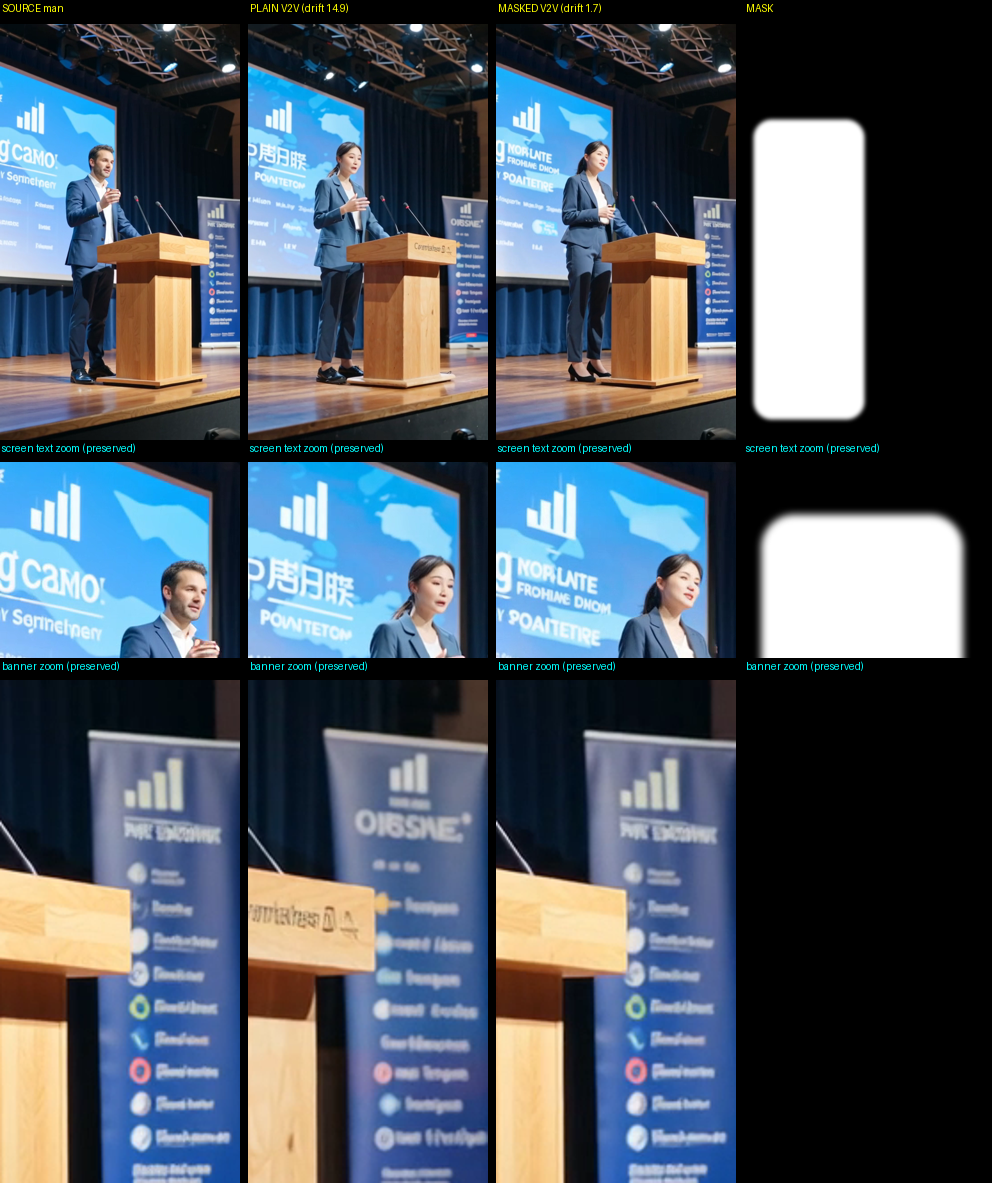
Measured preservation on that proof: preserved-region drift dropped from 14.9 (plain
video-to-video) to 1.7 mean per-pixel delta - at the measured H.264 re-encode floor of 1.9,
meaning preserved regions are indistinguishable from a lossless copy of the source. The edited
region still changed strongly (delta 23.4), so the man -> woman edit went through. Overhead
versus plain video-to-video is negligible (three elementwise blends per step).
VACE: Reference Images And Learned Mask Conditioning
Wan-AI/Wan2.1-VACE-1.3B-diffusers (alias wan-vace) is a natively ported single-transformer
Wan2.1 model with VACE conditioning blocks: instead of the SDEdit warm start that plain
video-to-video uses, VACE feeds the source video, the mask, and optional reference images
through learned control layers at every denoising step.
Why a Wan2.1 model: VACE is a Wan2.1-generation release - the only official Wan-AI VACE
checkpoints are Wan2.1-VACE-1.3B and Wan2.1-VACE-14B; there is no official Wan2.2 VACE
(the community alibaba-pai/Wan2.2-VACE-Fun-A14B is a third-party fine-tune in the 64 GB
class). The 1.3B checkpoint is the small official rung and the first Wan2.1 model in this
runtime; it reuses the same Wan2.1 16-channel VAE and UMT5-XXL encoder the A14B route already
ships, so the port adds the VACE control blocks rather than a new stack.
VACE buys two things the A14B routes cannot do:
- Reference-image object injection: pass
--reference-image object.png(repeatable) with a text prompt and no source video, and the model generates a new scene containing the pictured subject. Reference preparation decides whether this works: SEGMENT the subject onto a plain white background (the format the official VACE examples use). A rectangular crop that keeps background gives only a style-level match, and a full-scene reference loses the subject entirely - both failure modes are demonstrated in the proof bundle, and the identity claim is backed by a same-seed no-reference control. - Learned masked editing: pass
--video-path+--video-mask-pathand the white region is re-synthesized under prompt + reference guidance while the black region conditions the result through the VACE branch (a learned preserve, unlike the exact latent lock of masked A14B video-to-video; combine with the A14B masked route when you need codec-floor preservation).--vace-masked-regionselects what the model sees inside the white region: generate(default): the region is gray-filled before conditioning, following the official VACE inpainting convention ("gray = missing part"). The model synthesizes new structure there - use this to REPLACE or substantially transform an object (measured on the bundle case: silhouette IoU vs source 0.16-0.20 with in-mask change 63.8, against a 3.8-3.9 codec-floor background).repaint: the source content is kept as conditioning, so structure and motion are preserved and only style/color/materials change (measured: silhouette IoU 0.80-0.88, in-mask 14-17). Use this for recolor/restyle-in-place edits. Keep the mask a TIGHT corridor around the object's trajectory: an over-wide mask hands the model scenery it will re-render (a wide-mask iteration in the proof bundle recolored a cliff top that sat inside the editable region). The mask contract is the same as elsewhere: one static image, binarized at 50% - soft or per-frame masks are not part of the public surface yet. Do NOT also pass the source frame as--reference-imagewhen asking for a change: a self-reference anchors the subject to its current appearance and suppresses the edit even in repaint mode (measured: in-mask change dropped from ~15-17 to ~8-11).
Route contract:
--reference-imageand--conditioning-scaleare backend flags onmlxgen-generate-wan(themlxgen generaterouter forwards them unchanged);--solver unipconly;--video-strengthis rejected (no SDEdit warm start);--conditioning-scale(default1.0) scales the VACE branch at every control layer: higher values push the output harder toward the source video/mask/reference conditioning, lower values give the text prompt more freedom;- 480p-class canvases (
832x480/480x832; the 1.3B checkpoint is unstable at 720p per its model card); defaults: 81 frames, 30 steps, guidance 5.0, fps 16; - reference images and
--conditioning-scaleare recorded in metadata and replayed by--config-from-metadata; - measured cost (BF16,
--low-ram, M-series 128 GB host): 448x256x17f/16 steps = 239 s at ~11-12 GiB peak; 832x480x17-33f/20 steps = ~10-24 min at ~19-26 GiB; the flag-free defaults (832x480x81f/30 steps) = 1 h 56 min at 31.7 GiB - iterate at 17-33 frames and scale up when the composition is right.
What reference injection looks like end to end - the reference image (subject segmented onto white) is the ONLY visual input, the ocean scene is invented from the text, and the control row shows the same seed WITHOUT the reference producing an unrelated ship - the reference branch, not the prompt, carries the identity:

Reference-injection example (this exact command produced the "with reference" row above; the
control row is the same command without --reference-image):
mlxgen-generate-wan --model Wan-AI/Wan2.1-VACE-1.3B-diffusers \
  --reference-image ship_segmented_on_white.png \
  --prompt "The starship from the reference image flying low over a calm turquoise ocean at golden sunset, side view, large in frame, cinematic tracking shot, photorealistic" \
  --negative-prompt "duplicate ships, warped hull, washed out frame, blown highlights, tiny distant object" \
  --width 832 --height 480 --frames 17 --fps 16 --steps 20 --guidance 5.0 \
  --seed 4242 --low-ram --metadata --output ship_over_ocean.mp4
And the documented failure mode - the same request with a full-scene reference instead of a segmented subject loses the subject entirely (effectively a text-to-video result):

What a masked edit looks like end to end - request, inputs (source video + mask), and both mode outputs in one panel; the red overlay marks the only region the model may change. GENERATE mode replaces the ship with a new vehicle; REPAINT mode restyles the existing one in place. Same seed and source clip; the repaint row comes from its own earlier run with the wider union mask (16 steps, guidance 3.5), as the panel caption states:

Masked-edit example (this exact command produced the generate-mode row above; pass
--vace-masked-region repaint to restyle in place instead of replacing):
mlxgen-generate-wan --model Wan-AI/Wan2.1-VACE-1.3B-diffusers \
  --video-path source.mp4 \
  --video-mask-path ship_trajectory_corridor_mask.png \
  --prompt "Keep the same icy cliffs, snow haze, soft sunrise lighting, and lift-off camera motion. A massive bulky smuggler starship, wider and longer than the frame center, gritty weathered matte metal hull with a bright circular rear reactor and two side engine nacelles, rises steadily off the snow gaining altitude through the clip, photorealistic, film grain." \
  --negative-prompt "duplicate ships, warped hull, melted nacelles, unreadable reactor, washed out frame, blown highlights, iridescent, rainbow highlights, stylized, toon, painterly" \
  --width 448 --height 256 --fps 10 --frames 17 --steps 24 --guidance 5.0 \
  --seed 7302 --low-ram --metadata --output edited.mp4
Full proof bundle (parity evidence, request/inputs/output panels with controls, the upstream same-inputs A/B, exact commands, timings, the flag-free defaults-run cost, and the documented first-attempt pitfalls - self-reference suppressing edits, unsegmented references diluting identity): wan-vace-2026-07-06. The port is verified stage-by-stage against the diffusers reference: bit-exact mask preparation and scheduler, transformer deltas at the model's intrinsic fp32 noise floor.
Not yet demonstrated (honest gaps tracked in backlog 0080): person/identity injection and multi-reference generations (unit-verified only).
Fast Video-To-Video With Lightning
The lightx2v/Wan2.2-Lightning T2V-A14B 4-step LoRA pairs work on the video-to-video route
through the public unipc path, cutting the denoise loop from 28 transformer forwards
(20 steps, CFG on) to 3. Validated in a bounded matrix (two seeds, two clips at two
resolutions, two adapter versions, plus the masked combination):
Wan2.2-T2V-A14B-4steps-lora-rank64-Seko-V1.1 and ...-Seko-V2.0. The I2V-A14B and TI2V-5B
Lightning adapters do not apply here (public video-to-video runs on the T2V-A14B route only).
The on-grid recipe keeps the truncated schedule exactly on the 4-step distillation grid:
mlxgen download --model lightx2v/Wan2.2-Lightning --all-files

mlxgen generate \
  --model AbstractFramework/wan2.2-t2v-a14b-diffusers-8bit \
  --video-path source.mp4 \
  --prompt "..." \
  --steps 4 \
  --video-strength 0.75 \
  --guidance 1 \
  --guidance-2 1 \
  --flow-shift 5 \
  --solver unipc \
  --lora-paths "lightx2v/Wan2.2-Lightning:Wan2.2-T2V-A14B-4steps-lora-rank64-Seko-V1.1/high_noise_model.safetensors" \
               "lightx2v/Wan2.2-Lightning:Wan2.2-T2V-A14B-4steps-lora-rank64-Seko-V1.1/low_noise_model.safetensors" \
  --lora-target-roles high_noise_transformer low_noise_transformer \
  --low-ram --metadata \
  --output edited_fast.mp4
Contract and trade-offs:
- the strength setting is a lattice at 4 steps:
0.75-0.99gives 3 effective steps with the high-noise LoRA engaged,1.0gives 4, and0.7drops to 2 steps and silently skips the high-noise LoRA; - guidance 1 disables classifier-free guidance, so negative prompts have no effect on this recipe;
- without a mask, Lightning re-synthesizes the scene more than the 20-step CFG-on baseline (measured background drift 26-32 vs 15-17);
- Lightning cannot reach the motion-preserving band: strength 0.5-0.65 at 4 steps leaves 2 effective steps and drops the high-noise LoRA, so fast and motion-preserving are mutually exclusive - see Motion Fidelity Versus Strength;
- combine with
--video-mask-pathto remove that trade-off where it matters: the masked + Lightning combination measured preserved-region drift1.9- at the H.264 re-encode floor - while still applying the edit inside the mask.
Included proof: the matrix summary, metrics, and side-by-side comparison live in
docs/assets/validation/lightning-v2v-2026-07-04/,
and mlxgen capabilities reports this route's LoRA support as validated through the
lora_wan_a14b_q8_lightning_v2v_2026_07_04 profile.
A14B Size Families
The official A14B quality envelope centers on 480P and 720P, but MLX-Gen accepts a broader set
of 16-pixel-multiple target sizes for both A14B routes:
- square:
240x240,480x480,720x720,960x960,1280x1280,1440x1440 - portrait targets:
240x480,480x832,720x1280,832x1104,1248x1648,1080x1920 - landscape targets:
480x240,832x480,1280x720,1104x832,1648x1248,1920x1080
Practical reading:
480x240/240x480: quick local previews832x480/480x832: strong lower-cost working sizes1280x720/720x1280: better presentation-quality targets
For A14B image-to-video, treat these as target size classes rather than exact guarantees. MLX-Gen preserves the source image aspect ratio and resolves to the nearest supported canvas.
Output Canvas And Source Mapping
Two orthogonal options control geometry on routes that take a source input:
--canvas-policypicks the output canvas. Image-to-video defaults tosource-aspect: the requested--width/--heightact as a size target and the canvas is resolved from the source image ratio. Video-to-video defaults to the requested (multiple-adjusted) canvas. Passexact-resizeon image-to-video to honor the requested canvas exactly, orsource-aspecton video-to-video to derive the canvas from the clip. VACE requires the exact canvas and rejectssource-aspect.--resize-modepicks how source pixels (image-to-video first frame, video-to-video frames, VACE conditioning, and their masks) map onto that canvas:resizestretches to fill (default),cropcenter-crops without distortion,padletterboxes the full source without distortion. Masks always map through the same geometry as the pixels, so masked edits stay aligned; letterboxed borders count as preserved regions.
Both values are recorded in metadata and replayed by --config-from-metadata. When source and
canvas ratios differ by more than 2% under the stretching resize mode, plain video-to-video and
VACE print a warning. With --json-events, the start event carries the resolved output
width/height, so applications learn the final geometry before the first frame is generated.
Example Prompt
The comparison clips use this prompt:
A cinematic wide-angle movie shot of a massive futuristic starship taking off from a frozen tundra. The ship features sleek dark metallic armor. Two massive warp nacelles pulsate with intensely glowing blue plasma. Violent snow squalls and heavy blizzards whip around the hull. The swirling snow is illuminated by stark volumetric blue light from the engines. The camera slowly tilts up. The camera simulates a violent shake as the thrusters ignite. Massive clouds of pristine white snow and ice blast away from the launch pad. Photorealistic, highly detailed, dramatic lighting.
M5 Max Comparison Clips
| Model | Size | Steps | Frames / FPS | Approx. time on M5 Max | Asset |
|---|---|---|---|---|---|
| Wan2.2 TI2V-5B | 832x480 |
25 | 101 / 20 | 12 min | MP4 |
| Wan2.2 T2V-A14B | 480x240 |
25 | 101 / 20 | 30 min | MP4 |
| Wan2.2 TI2V-5B | 1280x704 |
25 | 101 / 20 | 35 min | MP4 |
TI2V-5B At 832x480

T2V-A14B At 480x240

TI2V-5B At 1280x704

Command Shape
Use A14B T2V when the prompt does not need an input image:
mlxgen generate \
  --model AbstractFramework/wan2.2-t2v-a14b-diffusers-8bit \
  --prompt "A cinematic wide-angle movie shot of a massive futuristic starship taking off from a frozen tundra. The ship features sleek dark metallic armor. Two massive warp nacelles pulsate with intensely glowing blue plasma. Violent snow squalls and heavy blizzards whip around the hull. The swirling snow is illuminated by stark volumetric blue light from the engines. The camera slowly tilts up. The camera simulates a violent shake as the thrusters ignite. Massive clouds of pristine white snow and ice blast away from the launch pad. Photorealistic, highly detailed, dramatic lighting." \
  --width 480 \
  --height 240 \
  --frames 101 \
  --steps 25 \
  --guidance 4 \
  --guidance-2 3 \
  --fps 20 \
  --seed 42 \
  --output starship_takeoff_a14b.mp4
Use TI2V-5B when you want the 5B route or first-frame image-to-video route:
mlxgen generate \
  --model AbstractFramework/wan2.2-ti2v-5b-diffusers-8bit \
  --prompt "A cinematic wide-angle movie shot of a massive futuristic starship taking off from a frozen tundra. The ship features sleek dark metallic armor. Two massive warp nacelles pulsate with intensely glowing blue plasma. Violent snow squalls and heavy blizzards whip around the hull. The swirling snow is illuminated by stark volumetric blue light from the engines. The camera slowly tilts up. The camera simulates a violent shake as the thrusters ignite. Massive clouds of pristine white snow and ice blast away from the launch pad. Photorealistic, highly detailed, dramatic lighting." \
  --width 832 \
  --height 480 \
  --frames 101 \
  --steps 25 \
  --guidance 5 \
  --flow-shift 3 \
  --fps 20 \
  --seed 42 \
  --output starship_takeoff_ti2v5b.mp4
For native TI2V-5B runs at 1280x704 or 704x1280, omit --flow-shift or pass --flow-shift 5.
For image-to-video, pass one --image. A14B I2V uses the separate
AbstractFramework/wan2.2-i2v-a14b-diffusers-8bit package; TI2V-5B uses the same TI2V package and
selects first-frame image-to-video when one image is supplied.
Use TI2V-5B image-to-video like this:
mlxgen generate \
  --model AbstractFramework/wan2.2-ti2v-5b-diffusers-8bit \
  --image docs/assets/examples/spaceship-snow/01_t2i_spaceship_snow.png \
  --prompt "A cinematic lift-off from the input frame. Keep the frozen cliffs, snow haze, and sunrise palette while the ship rises with glowing blue engines and drifting snow." \
  --width 832 \
  --height 480 \
  --frames 101 \
  --steps 25 \
  --guidance 5 \
  --flow-shift 3 \
  --fps 20 \
  --seed 42 \
  --output starship_takeoff_ti2v5b_i2v.mp4
Use TI2V-5B at its native landscape size like this:
mlxgen generate \
  --model AbstractFramework/wan2.2-ti2v-5b-diffusers-8bit \
  --prompt "A cinematic wide-angle movie shot of a massive futuristic starship taking off from a frozen tundra. The ship features sleek dark metallic armor. Two massive warp nacelles pulsate with intensely glowing blue plasma. Violent snow squalls and heavy blizzards whip around the hull. The swirling snow is illuminated by stark volumetric blue light from the engines. The camera slowly tilts up. The camera simulates a violent shake as the thrusters ignite. Massive clouds of pristine white snow and ice blast away from the launch pad. Photorealistic, highly detailed, dramatic lighting." \
  --width 1280 \
  --height 704 \
  --frames 101 \
  --steps 25 \
  --guidance 5 \
  --fps 20 \
  --seed 42 \
  --output starship_takeoff_ti2v5b_1280x704.mp4
Use A14B I2V like this:
mlxgen generate \
  --model AbstractFramework/wan2.2-i2v-a14b-diffusers-8bit \
  --image docs/assets/examples/spaceship-snow/01_t2i_spaceship_snow.png \
  --prompt "A cinematic lift-off from the input frame. Keep the same frozen landscape and sunrise tones while the ship rises with snow blast and glowing engines." \
  --width 480 \
  --height 240 \
  --frames 101 \
  --steps 25 \
  --guidance 4 \
  --guidance-2 3 \
  --fps 20 \
  --seed 42 \
  --output starship_takeoff_a14b_i2v.mp4
Use A14B T2V for the current plain public video-to-video route. This is the exact command that
produced the included proof artifacts. It uses bounded diagnostic settings (448x256, 17 frames,
5 requested steps, which resolve to 3 effective steps at --video-strength 0.7) so it runs in
about 4-5 minutes end to end (measured 298.7 s on 0.23.0, 13.8 GiB peak RSS with --low-ram);
it is a route and behavior proof, not a quality setting:
mlxgen generate \
  --model AbstractFramework/wan2.2-t2v-a14b-diffusers-8bit \
  --video-path docs/assets/examples/spaceship-snow/06_i2v_a14b_spaceship_takeoff_from_source.mp4 \
  --prompt "Keep the same icy cliffs, snow haze, soft sunrise lighting, and lift-off camera motion. Transform the ship into a bulkier smuggler-style starship with a bright circular rear reactor and two side nacelles while preserving realistic vehicle detail." \
  --negative-prompt "Bright tones, overexposed, static, blurred details, subtitles, paintings, still picture, low quality, JPEG residue, duplicate ships, warped hull, melted nacelles, unreadable reactor, washed out frame, blown highlights" \
  --width 448 \
  --height 256 \
  --frames 17 \
  --steps 5 \
  --guidance 4 \
  --guidance-2 3 \
  --video-strength 0.7 \
  --solver unipc \
  --fps 10 \
  --seed 4242 \
  --low-ram \
  --metadata \
  --output starship_v2v_a14b.mp4
For quality output rather than a route check, start from the A14B defaults and keep the strength
contract in mind: --width 832 --height 480 (or 1280x720), --frames 81, --steps 40
(about 32 effective steps at --video-strength 0.8), --fps 16. Expect a long run at those
settings; see the timing profiles above.
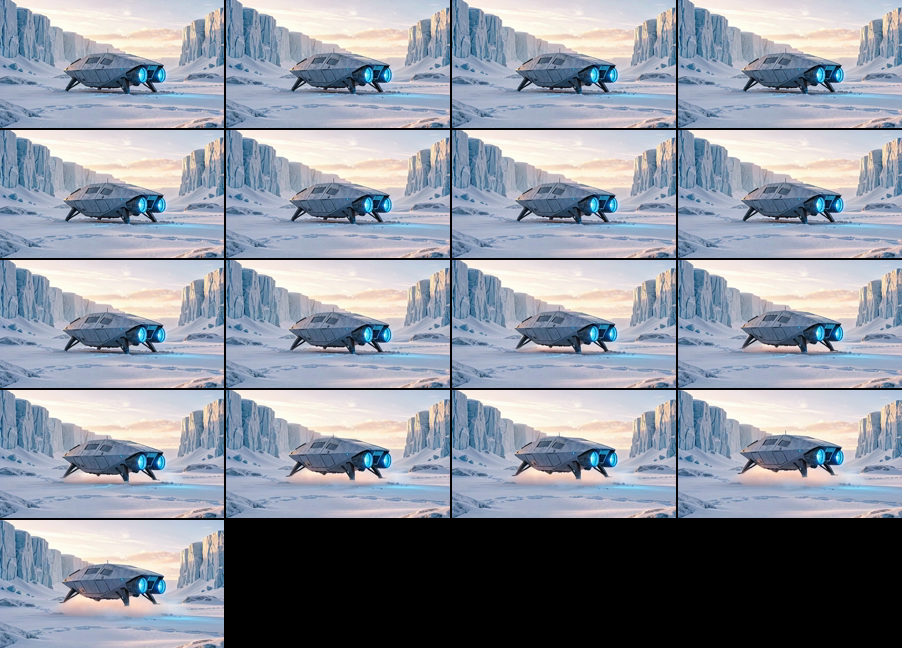
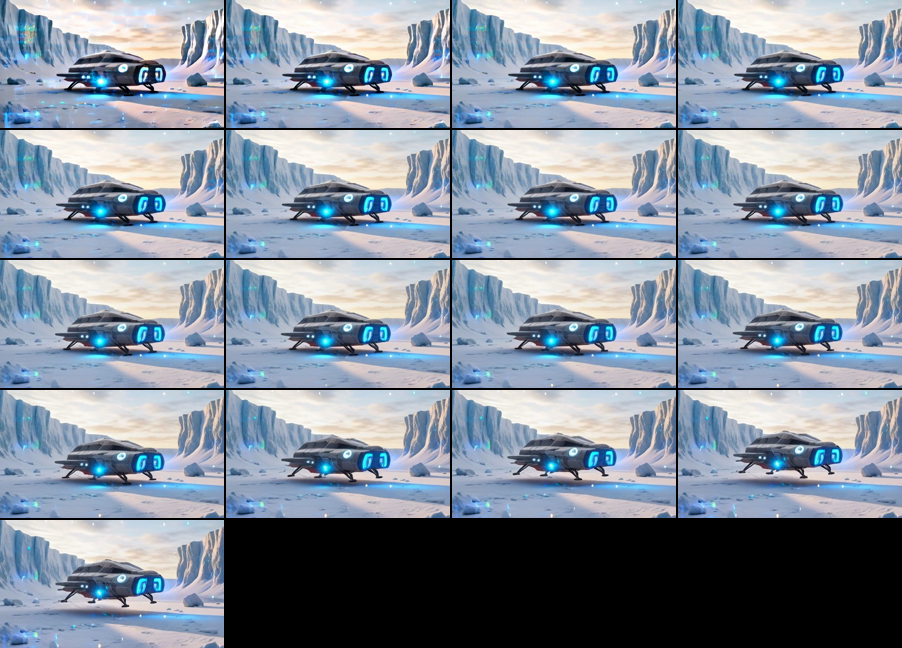
The proof used this source clip: 06_i2v_a14b_spaceship_takeoff_from_source.mp4
Included proof artifacts (see the proof card for the cross-release verification record — the 0.23.0 rerun reproduced the archived clip bit-identically):
- output video: starship_v2v_a14b.mp4
- run metadata: starship_v2v_a14b.metadata.json
- source contact sheet: starship_v2v_source_contact_sheet.png
- output contact sheet: starship_v2v_output_contact_sheet.png
Repeat-Run And Application Performance
Options that matter when Wan runs repeatedly in one process or inside an application:
- Prompt-embed disk cache (default on): identical prompt encodes are served from a small
on-disk cache instead of reloading the ~11 GB UMT5 text encoder. Opt out with
--no-prompt-cacheorprompt_embed_disk_cache=False. - Resident text encoder:
--keep-text-encoder/keep_text_encoder_resident=Truekeeps the UMT5 encoder loaded between generations in one process, for hosts that chain scene generations with new prompts. The default releases it after encoding. --no-validate-health: skips the post-save full-file health re-decode for applications that probe the saved file themselves. The skip is recorded ashealth_check: "skipped"in metadata and thesaveruntime event.--compile-transformer(opt-in): runs each denoiser as a compiled MLX graph for roughly 2-6% per-step gain. Output is close to but not bit-identical with eager mode, so it never becomes a default.- A14B inactive-expert release (automatic): on dual-expert A14B runs from disk-prequantized
packages, the ~14 GB high-noise expert is released after its denoise phase and rebuilt when the
next item needs it. Override with
--release-inactive-denoiser/--no-release-inactive-denoiser. --json-events: thestartevent carries resolved outputwidth/height; thesaveevent carriesfps,width,height,total_frames, andhealth_check, so applications can build artifact records without probe decodes.